Why Your Best Asset Sits Buried in Training Binders


The aim of this article is to expand your creativity and sell your unique business processes.
When you think “financial assets,” you probably think balance sheet entries: cash reserves, credit lines, investments.
But the truly hidden financial assets aren’t balance sheet items.
They’re operations you’re already running that function as financial instruments—you just don’t see them that way.
Lets lay out all your assets..
See below a small non-exhaustive list of assets that are often overlooked.
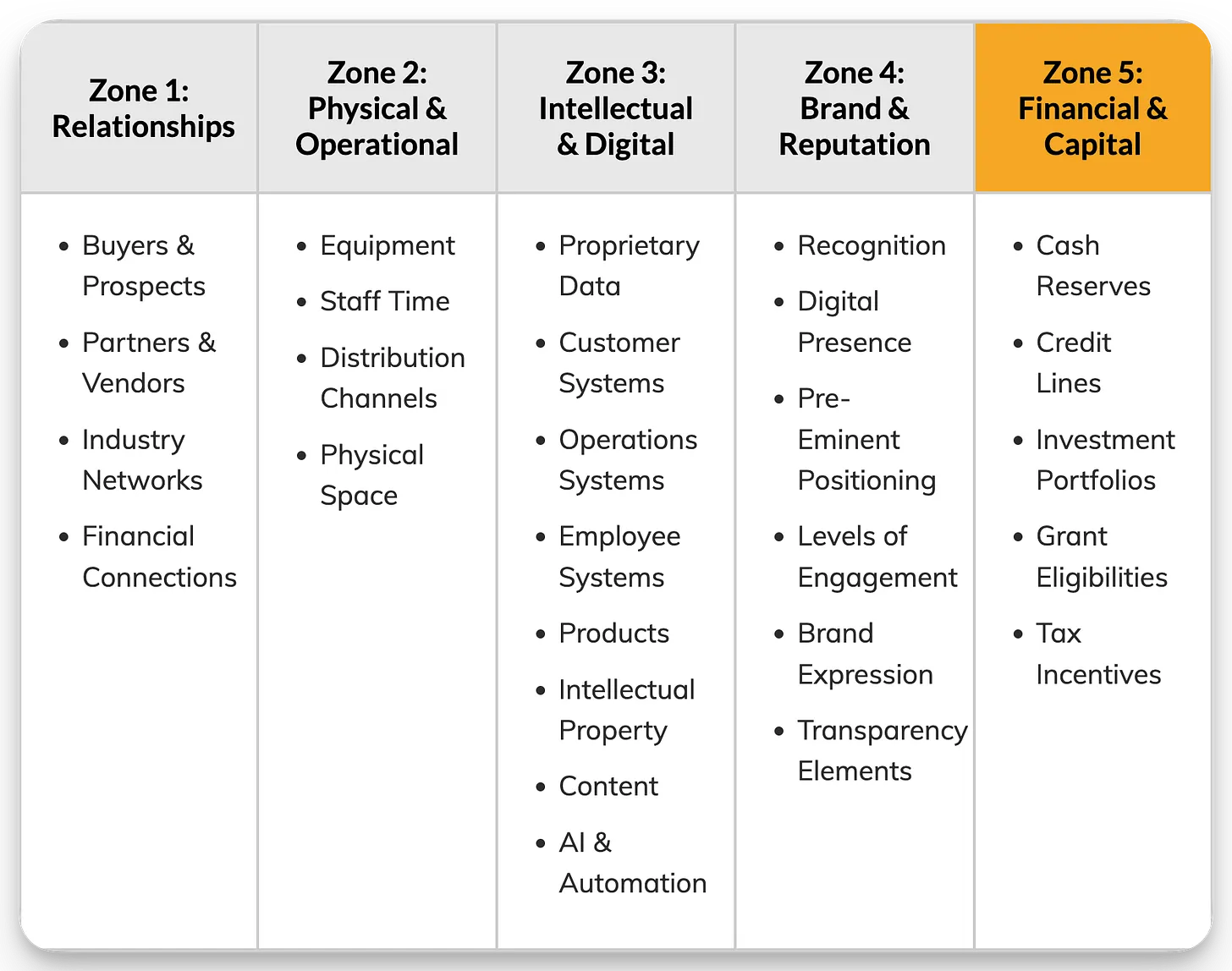
When considering for example your processes, and how that can be monitised, put yourself in the shoes of a smaller or less sophisticated business in a similar market to yours.
A truth that most never see:
The process you build to make the product might be worth more than the product itself.
Your processes' can be licensed!
Or at least, sold for training or up-skilling to another business.
Every time you document a process, you’re not just creating an asset for your employees–you’re also creating a product that could be sold anywhere in the world. A franchise manual works in Chicago and Tokyo. A training video plays for 10 people or 10,000. No extra staff. No freight. No inventory risk.
And here’s what most business owners miss: you don’t have to invent the perfect system yourself. Your best employees already cracked it. They’ve been refining it for years.
Your job is to extract what they know and package it
This is just one example..
Imagine if companies like McDonalds (they never would and that's why they are franchised) would licence their unique processes to other restaurants.
Or if highly efficient manufacturing companies licensed their processes to non-competitors.
Here are some examples to whet your appetite.
Tony Hsieh built Zappos around customer service so obsessive it became legendary. When other companies started asking how to build a culture like that, Hsieh packaged the answer. Zappos Insights now charges $20 for a headquarters tour and $6,000 per person for a 3-day boot camp. The service culture became a revenue stream that has nothing to do with selling shoes.
Jack Stack bought a failing engine plant in 1983 with a debt-to-equity ratio of 89 to 1. He saved it by teaching every employee to read financial statements, something he called “open-book management.” When other manufacturers started asking how, Stack wrote “The Great Game of Business” and launched a training company. The stock went from 10 cents to $361 per share. The management system he invented to avoid bankruptcy now gets licensed to thousands of companies.
Julia Child spent ten years systematizing French cooking into a 726-page cookbook. Houghton Mifflin rejected it. Knopf published it. “Mastering the Art of French Cooking” launched a television career and media empire. She never opened a restaurant. The method was the product.
Marie Poulin mastered Notion for her design work, then taught companies how to implement it. Her course, “Notion Mastery,” costs $1,249 and generates $40,000 a month.
Justin Welsh documented how he grew his LinkedIn following from 2,000 to 600,000 with zero ads. He packaged the system into courses priced between $150 and $897. Total revenue: $10 million. Total employees: one.
None of them set out to sell their process. They just noticed what was really making money.